Applied science. Real impact.
We develop original research and field-validated projects at the intersection of intelligent systems, sustainable infrastructure, and environmental resilience — designed to move from insight to application.
How research becomes action
A practical pathway from inquiry to implementation — designed to keep research grounded in real systems and institutions.
Research
We investigate high-impact questions across intelligent systems, infrastructure resilience, and environmental realities.
Frameworks
Findings are translated into decision frameworks that institutions and practitioners can actually use.
Prototypes
We shape testable concepts that connect technical possibilities with local constraints and user needs.
Applied Partnerships
We work with partners to pilot, validate, and adapt solutions for context-specific deployment.
Introducing AquaPulse
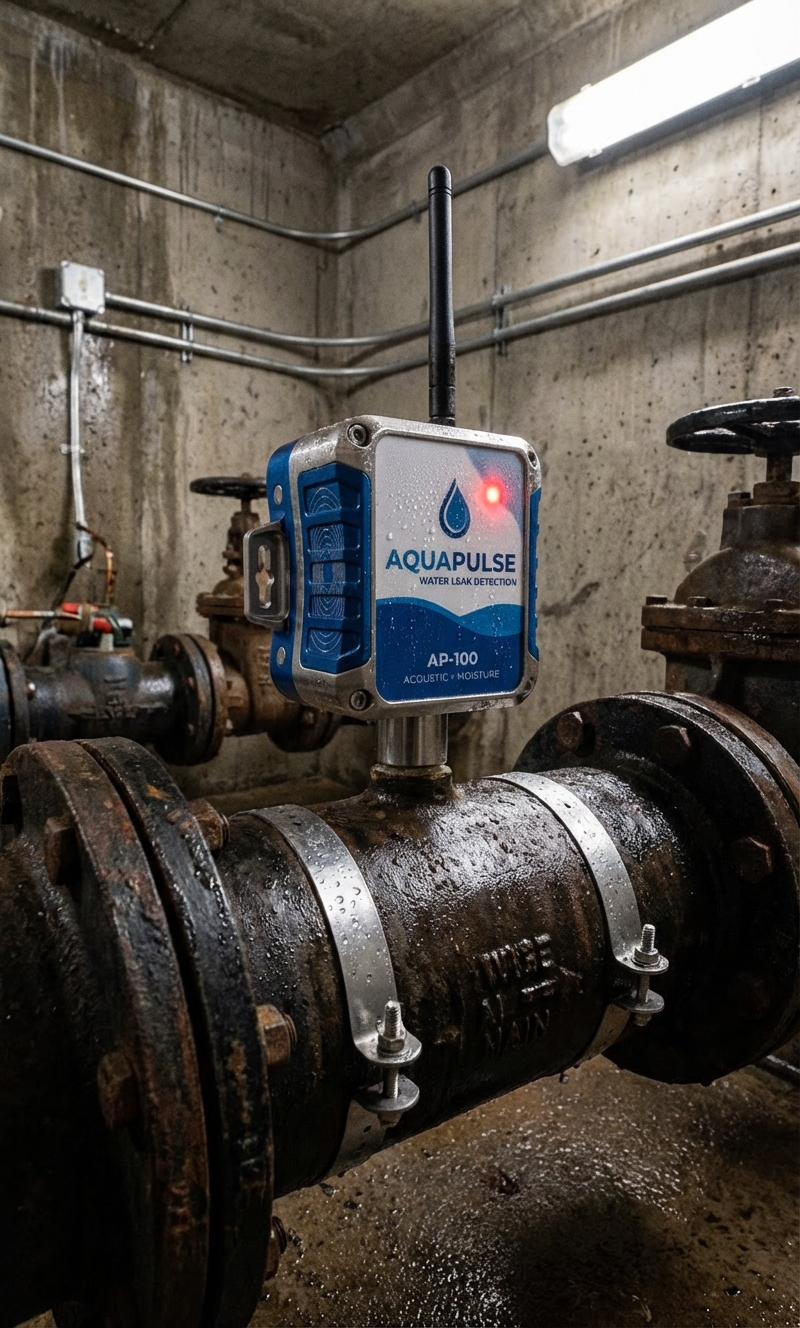
The AP-100 Smart Leak Detection Sensor — field-validated AI powering the world's water networks. The only solution combining acoustic sensing, soil moisture probing, and onboard AI at a fraction of existing costs.
- Dual sensing advantage: piezo-electric acoustic sensor + subsurface soil moisture probe — uniquely capturing leaks that acoustic-only systems miss.
- Onboard AST-MLP AI engine classifies leaks in near-real-time with interpretable attention maps. No black-box decisions.
- Solar-battery hybrid power — fully off-grid capable for rural, remote, and infrastructure-poor deployments.
- Non-invasive clamp-on installation to valves, hydrants, and pipe saddles. No excavation. No service interruption.
- Real-time alerts via cloud dashboard, WiFi, 4G, and SMS. Peer-reviewed research submitted to Water Research (Elsevier, IF: 12.4).
How AquaPulse stands apart
| Feature | AquaPulse AP-100 | Echologics LeakFinderST | HWM Permalog+ | Sewerin CORRELUX P-2 |
|---|---|---|---|---|
| Detection Method | Acoustic + Moisture Unique | Acoustic only | Noise logging only | Acoustic correlation |
| AI / Machine Learning | ✓ 94% accuracy | Cross-correlation only | Cloud analytics | ✗ |
| Real-time Alerts | ✓ Cloud + SMS | ✗ | Partial (scheduled) | ✗ |
| Moisture Sensing | ✓ Unique advantage | ✗ | ✗ | ✗ |
| Off-grid / Solar Power | ✓ Fully capable | ✗ | Battery only | Battery only |
| Cost per Unit (est.) | $800 – $1,500 | >$15,000 | >$8,000 | >$5,000 |
| Emerging Market Fit | Excellent | Poor | Moderate | Moderate |
Featured research

Generative AI in Construction: A Delphi Approach, Framework & Case Study
Delphi-informed framework showing practical pathways for generative AI integration in construction systems.

Generative AI in the Construction Industry: A State-of-the-art Analysis
A concise synthesis of opportunities, constraints, and implementation conditions for generative AI in construction workflows.

Geotechnical Characterization of Biochar-Based Biocover
Geotechnical study supporting sustainable environmental cover systems with practical implications for resilient infrastructure.

Polymer-Enhanced Concrete: Innovations & Pathways for Resilient Materials
Comprehensive review focused on durability, sustainability performance, and resilient construction pathways.

Dynamic Cone Penetration Resistance of Fibre-Reinforced Road Subgrades
Investigation of reinforced subgrade behavior for stronger road performance under demanding geotechnical conditions.

Performance of Polypropylene Fiber in Compacted Residual Soil for Pavement Applications
Performance-oriented material study supporting practical soil improvement strategies for pavement applications.
Completed projects
Polymer-Enhanced Concrete
A structured review of polymer-enhanced concrete innovations with emphasis on durability, resilience, and sustainable pathways for construction systems.
Generative AI in Construction
A Delphi-guided research framework with a practical case-study pathway showing how generative AI can support construction decision systems.
Watch & learn
Visual overviews of our research approach, lab methodology, and project concepts in development.


Concepts in development
Ideas moving from insight to prototype — each targeting an underserved gap in water, environment, and infrastructure intelligence.
BoreholeIQ
AquaCheck
FloodSense Nigeria
PureFlow
HydroScout
Our research principles
Human-Centred AI
We design intelligence systems around human judgment, transparency, and social relevance — never the other way around.
Evidence-Led Decisions
Our recommendations are grounded in tested data, validated methods, and contextual interpretation of real-world systems.
Sustainability by Design
Environmental resilience and long-term viability are embedded at concept and implementation stages — not added on later.
Collaborate with the lab
We welcome institutional conversations, applied research collaborations, and partnership opportunities focused on intelligent systems, sustainable infrastructure, and environmental resilience.